
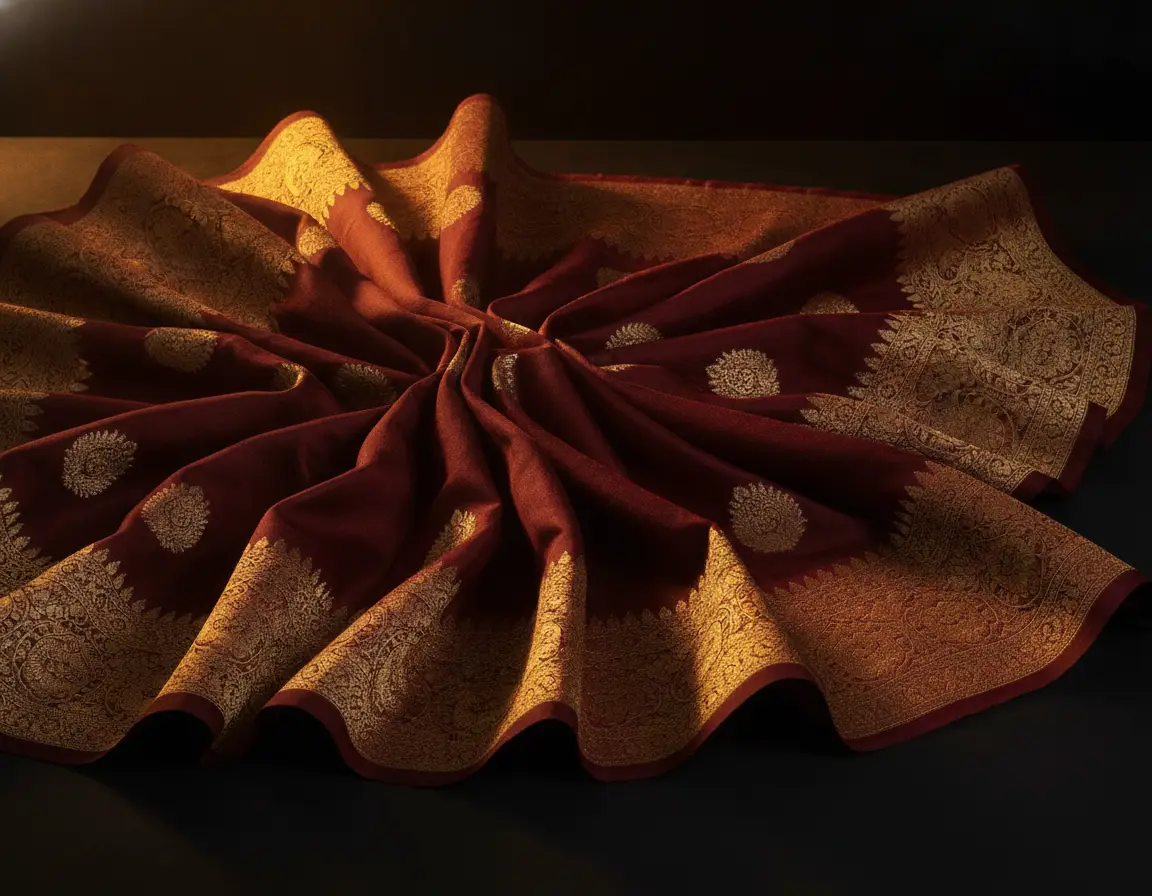
A good silk saree can outlive its first owner. The Kanjivarams and Banarasis that arrive at our saree studio in the best condition are rarely the least worn — they are the best kept. Silk does not ask for much, but what it asks for is specific: dry air, darkness, movement and restraint. Here is the routine we recommend to every client, and the honest line between what you should do at home and what you should hand to a professional.
In this guide
Why silk needs different care
Silk is a protein fibre — closer in chemistry to your hair than to cotton. That is why it takes dye so richly and drapes the way it does, and also why it reacts badly to the things that do not bother cotton: prolonged moisture, alkaline detergents, direct sunlight and hot irons. Water swells the fibre and can leave permanent rings; sunlight fades dyes unevenly; alkaline soap dulls the surface sheen that makes silk look like silk.
None of this makes silk fragile in daily life. It makes it particular. A saree treated on its own terms will keep its colour and fall for decades.
What to do right after wearing
- Air it before you store it. Hang the saree over a clean, padded rod for a few hours in shade — never in the sun. Body warmth and humidity need to leave the fabric before it is put away.
- Check the hemline and pleats. Dust and floor contact concentrate at the fall. Brush gently with a soft, dry cloth.
- Do not spray perfume or deodorant on the saree. Alcohol and oils in sprays cause the yellow patches you see months later. Apply fragrance before draping, to skin only.
- Note any contact stains now. Food, makeup or perspiration marks are far easier to remove fresh. If you see one, keep the saree aside for cleaning rather than storing it stained — stains oxidise and set in storage.
Storing silk sarees correctly
The storage rules are simple and mostly about what to avoid:
- Breathable wrapping only. Cotton or muslin cloth, or acid-free tissue. Never polythene bags or the plastic sleeves sarees are sold in — trapped moisture is how mildew and yellowing start.
- Dark, dry, cool. A wardrobe shelf away from external walls is better than a loft or a bathroom-adjacent cupboard.
- Keep silks with silks. Zippers, hooks and embellishments on neighbouring garments snag silk. Give sarees their own shelf or box.
- Moth care without mothballs. Naphthalene can react with zari and leaves an odour silk holds onto. Use dried neem leaves or cloves in a muslin pouch, kept beside — not touching — the fabric.

Airing and refolding
The single habit that separates well-kept sarees from damaged ones: take them out every three to four months. Air each saree in shade for a few hours, then refold along different lines before putting it back. Permanent creases are where fibres — and especially metallic zari threads — eventually crack. For heavy zari sarees, rolling around a fabric-covered tube is better than folding at all.
“We can fix almost anything except a fold that has been ironed into the same line for ten years.” — our head of the saree studio
Spot care: what is safe at home
Honest answer: very little, and that is not a sales line — home treatment is the most common cause of the permanent damage we see. Safe first aid:
- Blot, never rub. Press a clean, dry, white cloth onto the stain to lift what it will. Rubbing spreads the stain and abrades the surface.
- No water on visible stains. Water rings on silk are often more visible than the original mark.
- No home remedies. Lemon, vinegar, talcum, toothpaste — each has a saree it has ruined. Heat and time set stains; remedies plus a hot iron set them permanently.
- Get it to a professional within days, and tell us what the stain is. Knowing it is turmeric versus tea changes the chemistry we use. More in our guide to removing common stains.
When to send a saree for dry cleaning
Not after every wear. Professional cleaning is warranted when:
- There is a visible stain, or the saree was worn around food service;
- The saree absorbed heavy perspiration (blouse-contact areas of the drape);
- It smells of smoke, fragrance or storage;
- It is coming out of, or going into, long-term storage — cleaning before storage prevents oxidised yellowing;
- The fall is greying or the fabric has lost its hand-feel.
At the House, sarees are dry cleaned by hand — dye and trim tested first, zari protected, then steamed and rolled rather than pressed flat. Add-ons like polishing, fall stitching and preservation boxing are done in the same studio. If you are in Bangalore, pickup is complimentary.
Special care for zari and heavy work
Zari is metal — traditionally silver-gilt, now often copper or polyester-film based. Metal tarnishes with moisture and sulphur (rubber bands, some papers), and cracks at folds. For zari-heavy and hand-embroidered sarees:
- Roll instead of folding wherever possible;
- Interleave with acid-free tissue, and never secure with rubber bands;
- Keep silica gel pouches in the storage box in humid months;
- Have tarnish addressed professionally — home polishing abrades the thread. Our saree polishing service restores shine safely.
Frequently asked questions
How often should a silk saree be dry cleaned?
Only when it needs it — after visible soiling, food or makeup contact, or heavy perspiration. A saree worn briefly in a clean environment usually needs airing and re-rolling, not cleaning. Over-cleaning is its own form of wear.
Can I wash a silk saree at home?
We do not recommend it, even for “washable” silks. Water can bleed dyes, water-mark the fabric and dull zari. Home washing is the most common cause of irreversible saree damage that reaches our studio.
Can I iron a silk saree?
Use the lowest silk setting, no steam directly on zari, and always iron on the reverse with a cotton cloth in between. Better: hang the saree in a steamy bathroom for ten minutes and let gravity do it.
How should zari sarees be stored?
Rolled or folded with acid-free tissue between layers, wrapped in breathable cotton or muslin, away from light and moisture, refolded along different lines every few months so the metallic threads do not crack.